

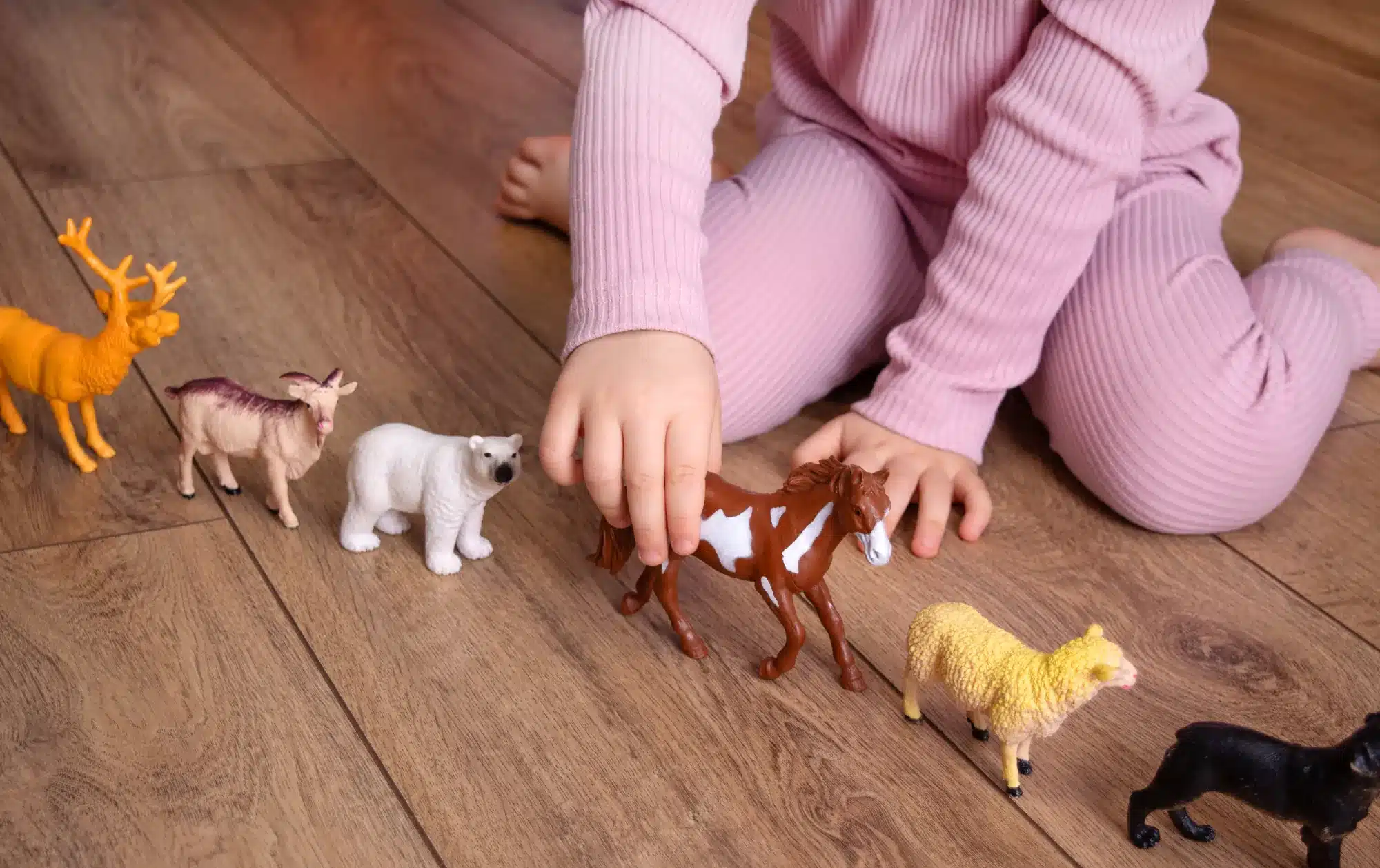
It is one of the most common things parents ask me, sometimes a little apologetically: “Isn’t it just playing?” Often a grandparent or partner has asked the same thing. Is it worth the drive and the time off work for your child to play with toys once a week?
It’s a good question, and you deserve a straight answer. From the outside, play therapy can look like ordinary play. But there is a lot going on underneath. The research is encouraging too, with some honest limits that I think you should know about.
Why play is how young children communicate
Think about how you handle a hard day. You probably talk it through with someone, or at least think it through in words. That takes skills most young children don’t have yet: naming feelings, explaining cause and effect, stepping back to reflect on their own behavior.
What young children do have is play. A child who is worried about a parent leaving might make a toy family say goodbye again and again. A child who has been through something frightening might crash cars or build walls and knock them down. Play is where children work things out.
The Association for Play Therapy sums it up this way: “toys are like the child’s words and play is the child’s language” (APT). The American Academy of Child and Adolescent Psychiatry describes play therapy as using toys, dolls, puppets, drawings and games “to help the child recognize, identify, and verbalize feelings” (AACAP, 2019).
So when your child plays in therapy, they aren’t avoiding the problem. For a young child, play is often the most direct way to reach it.
What is the therapist actually doing?
This is the part that’s easy to miss if you peek into the room. The Association for Play Therapy defines play therapy as “the systematic use of a theoretical model” in which trained therapists “use the therapeutic powers of play to help clients prevent or resolve psychosocial difficulties” (APT). The key words are systematic and trained.
In my playroom, while your child plays, I am:
- Paying close attention. I watch what your child chooses, what they avoid, and which stories keep coming back. Themes often show up in play long before a child could put them into words.
- Reflecting feelings. I might say, “That dinosaur is really angry,” or “You worked hard on that.” This helps a child notice and name what they feel, which is a first step toward managing it.
- Setting limits calmly. The playroom is a safe place, not a place with no rules. Learning to stop, wait or choose another way in the moment is part of the work.
- Letting your child lead, on purpose. For many children, especially those who feel anxious or out of control, being the one in charge of the play builds confidence and a sense of safety.
- Connecting it back to home. I share the themes I’m noticing with you, and practical ideas you can use between sessions.
You may notice something similar at home over time: a child who can say “I’m mad” instead of throwing a toy, or who can tell you they’re scared before a big change. If worry is a big part of your child’s life, you might also find my page on anxiety useful.
Does play therapy work? What the research says
Here’s the honest summary: a good number of studies over several decades suggest play therapy helps many children, and parent involvement seems to matter. The research also has real weaknesses. Both parts are worth knowing.
Large research reviews. A 2005 meta-analysis pooled results from 93 controlled studies published between 1953 and 2000. On average, children who received play therapy did noticeably better than children who didn’t. Play therapy “appeared equally effective across age, gender, and presenting issue,” and involving parents produced the largest effects (Bratton et al., 2005).
A 2015 review focused on child-centered play therapy, the style many play therapists use. It looked at 52 controlled studies and found a moderate positive effect overall. Children who received it scored, on average, about half a standard deviation better on outcome measures than children who received no treatment. Improvements showed up in behavior problems, stress in the parent-child relationship, and children’s belief in their own abilities. Effects were larger when caregivers were fully involved (Lin & Bratton, 2015).
A 2020 systematic review of individual play therapy for children aged 4 to 12 was stricter about which studies it counted. From more than 5,000 citations and 180 closely reviewed studies, only 17 met its criteria. Results varied widely, but most effect sizes fell in a small-to-large range, and the authors concluded that across most concerns, play therapy “was affirmed as an empirically supported therapy” (Drisko et al., 2020).
The honest limits of the research
I’d be doing you a disservice if I only shared the good news. Here’s what the researchers themselves point out:
- Many studies are small. The 2015 review noted small sample sizes in individual studies, which limits how far the results can be generalized (Lin & Bratton, 2015).
- Published studies look better than unpublished ones. In the same review, published studies showed larger effects than unpublished ones. That’s a common pattern in research, and it suggests the true average effect may be somewhat smaller than the headline number.
- Quality varies. Only 17 of 180 studies met the stricter 2020 review’s criteria (Drisko et al., 2020). The Health Evidence database rates the quality of the 2005 review as moderate (Health Evidence).
- Evidence for specific problems is thinner. A systematic review of child-centered play therapy for children who had experienced trauma found only seven studies. It noted “some consistency” in improvements in anxiety-type problems and self-concept, but also wide variation in how outcomes were measured and limits in study methods (Humble et al., 2019).
What does that mean for you? Play therapy has a real research base and is a reasonable, well-supported choice for many young children. It isn’t a guaranteed fix, and for some problems other approaches have stronger evidence. In those cases, I’ll tell you so.
Signs it’s working (and what to do if it isn’t)
Change is usually gradual. Parents often tell me the first things they notice are small: a quicker recovery after a meltdown, a new word for a feeling, a bedtime that’s a little less of a battle. Sometimes things get a bit bumpier before they settle, as a child starts working through something hard.
We’ll check in regularly about what you’re seeing at home and at school. If, after a fair amount of time, things aren’t moving, we’ll talk openly about adjusting the plan or trying a different approach. And if you have health or developmental concerns, please keep your pediatrician in the loop as well.
If you’re curious what the very first appointment involves, I’ve written about what to expect in your first therapy session. You can also read more about how I use play therapy with children ages 3 to 12.
Talk it through with me
If you’re still wondering whether “just playing” could really help your child, let’s talk. I offer a free phone consultation where you can describe what’s going on, ask me anything about how play therapy works, and decide whether it feels like the right next step. Call me at 503-495-5072, or send a message through my contact page. My office is in King City, a few minutes from central Tigard.
Sources
- Association for Play Therapy. “Why Play Therapy?” and “Play Therapy Makes a Difference.” https://www.a4pt.org/page/WhyPlayTherapy and https://www.a4pt.org/page/PTMakesADifference
- American Academy of Child and Adolescent Psychiatry. “Psychotherapy for Children and Adolescents: Different Types.” Facts for Families No. 86, updated April 2019. https://www.aacap.org/AACAP/Families_and_Youth/Facts_for_Families/FFF-Guide/Psychotherapies-For-Children-And-Adolescents-086.aspx
- Bratton, S. C., Ray, D., Rhine, T., & Jones, L. (2005). The efficacy of play therapy with children: A meta-analytic review of treatment outcomes. Professional Psychology: Research and Practice, 36(4), 376–390. https://doi.org/10.1037/0735-7028.36.4.376 (abstract and quality rating: https://www.healthevidence.org/view-article.aspx?a=efficacy-play-therapy-children-meta-analytic-review-treatment-outcomes-20123)
- Lin, Y.-W., & Bratton, S. C. (2015). A meta-analytic review of child-centered play therapy approaches. Journal of Counseling & Development, 93(1), 45–58. https://doi.org/10.1002/j.1556-6676.2015.00180.x
- Drisko, J., Corvino, P., Kelly, L., & Nielson, J. (2020). Is individual child play therapy effective? Research on Social Work Practice, 30(7), 715–723. https://doi.org/10.1177/1049731519854157
- Humble, J. J., Summers, N. L., Villarreal, V., et al. (2019). Child-centered play therapy for youths who have experienced trauma: A systematic literature review. Journal of Child & Adolescent Trauma, 12, 365–375. https://doi.org/10.1007/s40653-018-0235-7